
Duolingo has millions of users, beautiful graphics and a powerful motivation system. But is that enough to learn a foreign language? It’s no secret that we recommend using Duolingo as a fun addition to your study plan, not as your main way of learning. Still, I personally love mobile apps, so in February 2022, I decided to test it. With a heavy heart, I set a strict rule: I would ignore all of Lydka’s advice – no conversations, books, or workbooks, not even my beloved podcasts! My sole guide in learning the language would be Duolingo. So, how far did I get with this approach in two years and 73,207 XP of Norwegian? You’ll find out in this Duolingo review.
I chose Norwegian for this experiment; Scandinavia has intrigued me as a travel destination for some time now, and Norwegian looked more appealing than Swedish with all its ä’s, ö’s, and ü’s. 🙂 I downloaded Duolingo on my phone, set it to learn Norwegian through English, and dove right in.
In this Duolingo review, you’ll find out:
- First impression: learning Norwegian might be a bit easier than I thought
- A trip to Norway after a year and a half – lost in Oslo?
- First conversation after 600 days – a rough experience and a confused tutor
- How did the tutor assess my level?
- How would I assess my level?
- How much did my German and English knowledge help me learn Norwegian?
- Cards on the table: What’s my opinion of Duolingo?
- Quantity over quality?
- Is Super Duolingo worth it?
- Summary: pros and cons of Duolingo
First impression: learning Norwegian might be a bit easier than I thought
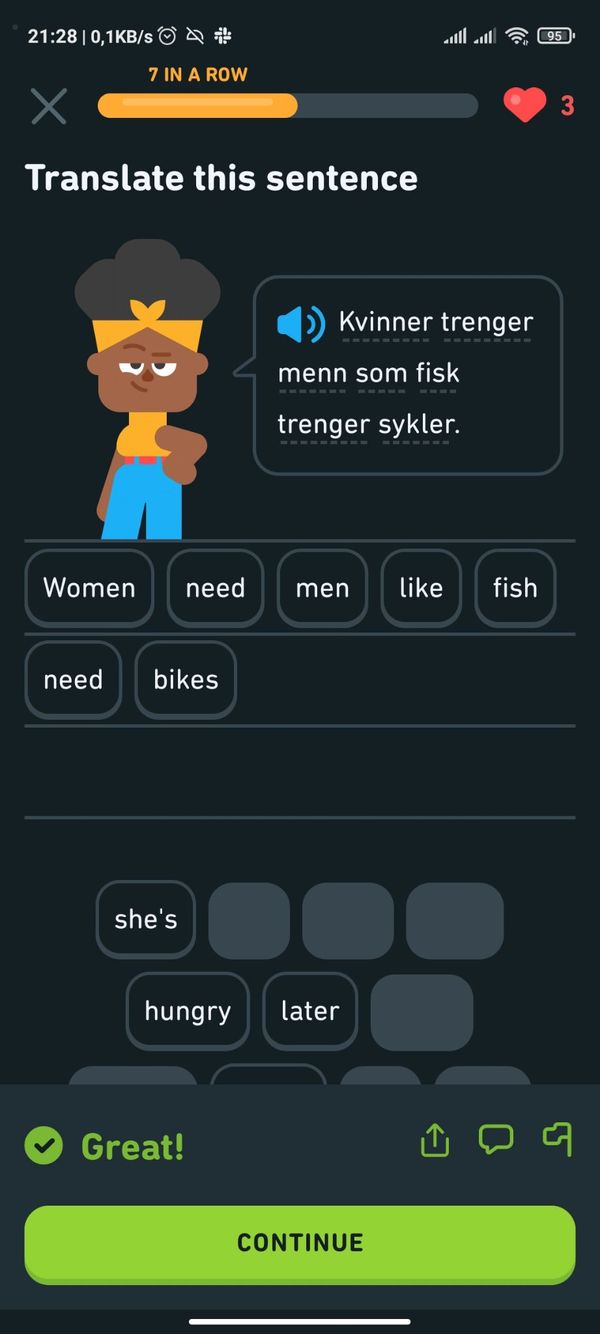
I got a pleasant surprise right away: Norwegian is very similar to English and German, both languages I already knew at this point! (You guessed it – I hadn’t researched anything about Norwegian before starting; I just jumped right in. 🙂 ) I understood about 10-15% right away, so I suspected Norwegian would be a bit easier for me than something like Italian, for example. Well, it turned out that while I had a slight head start in some aspects, German also held me back in others. How? You’ll find out later in the article. 🙂
Every day, I spent some time with Duolingo – occasionally as much as one hour, but sometimes just a quick 5 minutes. On average, I’d say I learned for about 10-15 minutes a day.
A trip to Norway after a year and a half – lost in Oslo?
In the summer of 2023, I went to Oslo for four days to visit some friends. You can imagine how thrilled I was to be able to read the signs at the airport! I also understood the announcement on the train telling me to use the door on the left. 🙂 In the museums I visited, I could understand to a degree the texts by the exhibits, but reading them was so tiring and time-consuming that I had to make do with their English translations instead.
As for speaking, aside from “Hei” (Hello) and “Tusen takk” (Thank you very much), I didn’t manage to say anything. When a cashier in a store offered me a bag, by the time my brain had decoded the sentence, my friend had already answered for me, “Nei, takk.” (No, thank you). So, my speaking skills in Norwegian were non-existent, and I had to rely on English.









First conversation after 600 days – a rough experience and a confused tutor
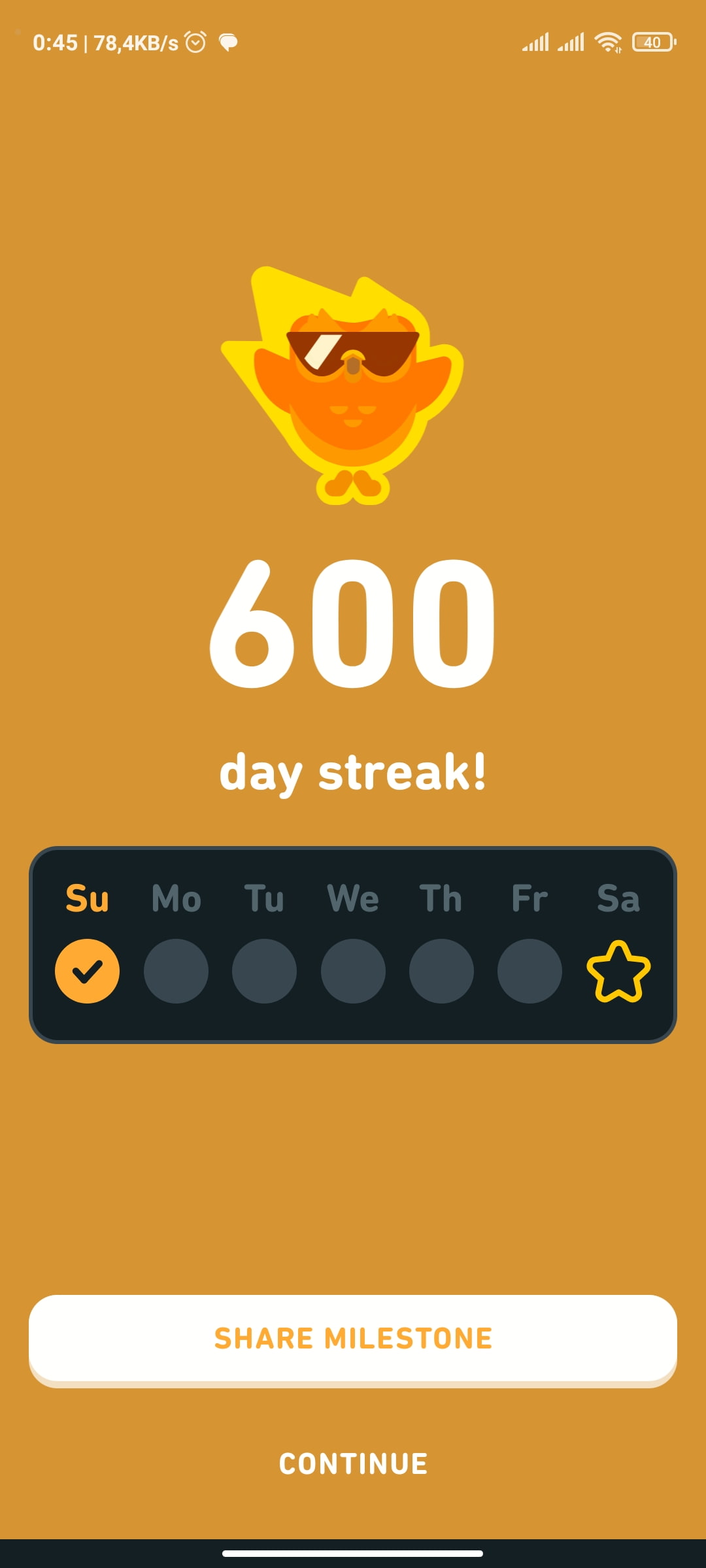
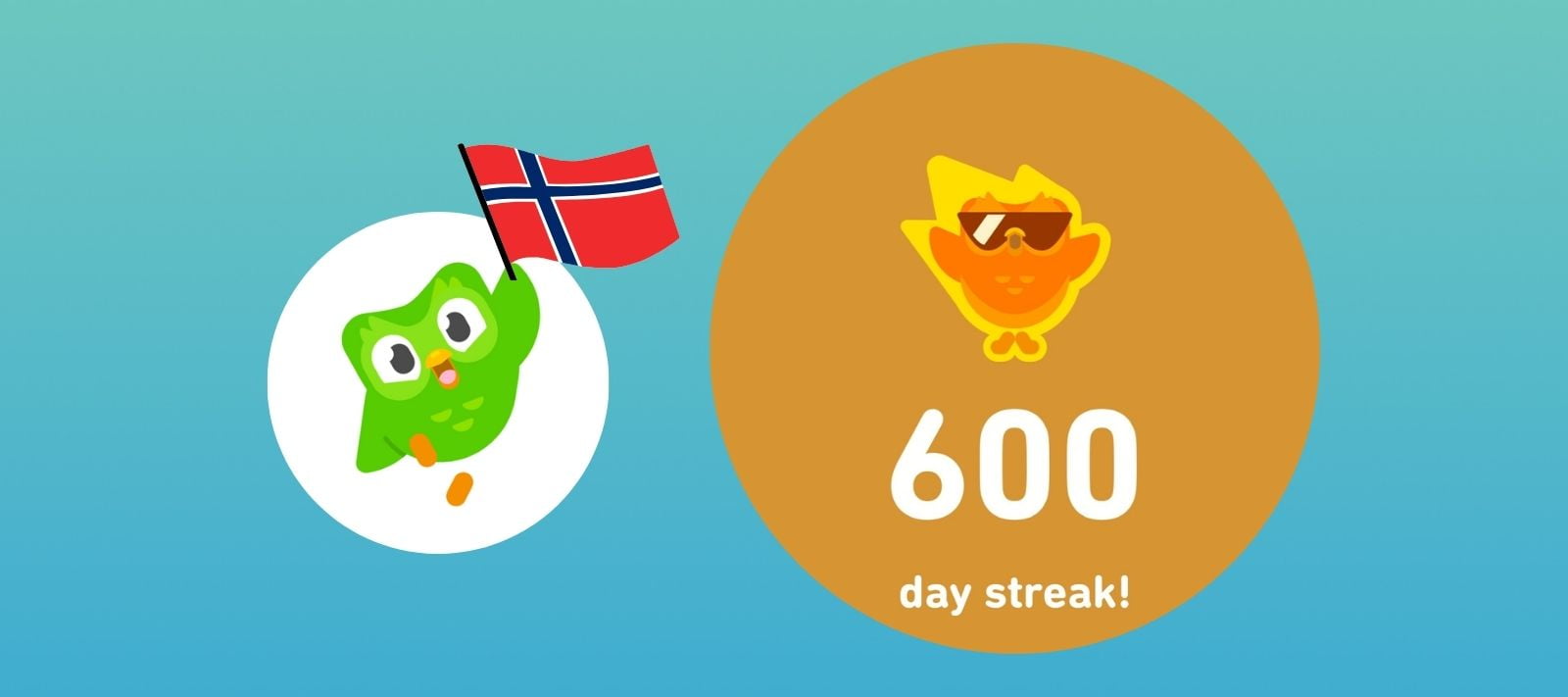
In January 2024, Duolingo let me know that I had reached a 600-day streak. It was time to assess how far I had made it in those nearly two years. I arranged an online conversation lesson with a tutor called Irena, a polyglot who has lived in Norway for many years and teaches Norwegian.
Since I wanted to test my level of Norwegian, we agreed to start with some casual conversation and then Irena would give me a text to read, followed by a discussion about it. The text was meant to be a bit more difficult, so that my understanding of it would require more than just my background knowledge of English and German and I would actually need to rely on my Duolingo-acquired Norwegian skills.
If you’ve ever had your first conversation in a foreign language, you definitely know the feeling of nervousness combined with excitement about trying something new, something completely outside your comfort zone. I took a deep breath and joined the Zoom call, where Irena was already waiting for me.
After some small-talk in English, she switched to Norwegian. I was shocked! Is this what Norwegian sounds like? Those two voices on Duolingo certainly hadn’t prepared me for this. 😀 I needed her to repeat the question, but I was so stressed out I forgot how to ask that, so I ended up resorting to gestures.
As the conversation continued, I did gradually become used to Irena’s accent. I started to understand her quite well and was even able to respond fairly decently. Overall, the first part, where I talked about my name, where I’m from, my age, and my trip to Oslo, went well.
The article made me pour sweat
Next, it was time to read an article from a textbook. I read it and understood that it was about immigrants to Norway, posing the question of when an immigrant can consider themselves Norwegian. Is it when they receive Norwegian citizenship and a passport? Or when they can speak fluent Norwegian? Where does one draw the line? And when does it no longer matter which country the person originally comes from?
I didn’t understand everything by far, as it was quite a difficult B2-level text, but I was able to grasp the main ideas.
Irena asked me about the text and my opinion on the topic. I found formulating my thoughts in Norwegian extremely difficult. I felt myself slipping more and more into German – German words were swirling in my mind, and I was automatically putting my verbs at the end of sentences, even though Norwegian has a word order similar to English. Needless to say, by the end of the conversation, I was drenched in sweat. 😀
How did the tutor assess my level?
First of all, Irena praised me for doing very well throughout the lesson. She said I could understand a B2-level text and have a basic conversation, which was great. On the other hand, she noted I’d made some very basic A1-level mistakes, things that she would normally be explaining to absolute beginners.
Since I had never spoken Norwegian before, my pronunciation was not great. Additionally, since Irena also speaks German, she was able to point out all the instances where it influenced my Norwegian (and there were quite a few). So, overall, she was a bit confused about my level. 🙂
How would I assess my level?
When Irena praised me, saying she would estimate my level at B1, I was initially pleased. But then I realized that achieving B1 in 600 days isn’t a particularly remarkable result, especially considering the slight head start I’d had thanks to English and German. As a tourist, I could get by to some extent, but if I had dedicated those 10-15 minutes a day to proper learning materials – podcasts, grammar exercises, weekly conversation lessons – I would be fluent within a year, and today I would be able to discuss just about anything in Norwegian. I’d probably even understand several Norwegian dialects (which change gradually from village to village).
How much did my knowledge of German and English help me in learning Norwegian?
As I mentioned, German turned out to be an obstacle in speaking, but at the same time, I felt it helped me in passive understanding. To what extent, you might ask. Well, I decided to find out through another experiment. I gave the article from the lesson to my colleague Daška to read. She is also fluent in English and German but has never learned Norwegian. Would that be enough for her to understand the article?
The answer is – partially. Daška managed to grasp the general topics of the text – immigration, nationality, citizenship, “something about Pakistanis”. However, what she didn’t catch, were the relationships between these topics – when an immigrant (for example, a Pakistani) becomes Norwegian and what impact our nationality has on our acceptance in society.
I concluded that German helped Daška to some extent, as many content words (words with a concrete meaning) in Norwegian are similar to German: “Innvandrer” vs. “Einwanderer” (immigrant) or “Statsborgerskap” vs. “Staatsbürgerschaft” (citizenship). However, the key to understanding the ideas in a text lies in the function words (grammatical words), most of which are different in Norwegian and German. Without words like “when” (når vs. wenn) or negation (ikke vs. nicht), it’s difficult to comprehend the relationships between the words you understand, so the main idea is likely to escape you. Unlike Daška, I knew these little words from Duolingo, and they helped me a lot.
Cards on the table: What’s my honest opinion of Duolingo?
Let me first rate Duolingo against the three principles the Lydka Method is built on:
1. Will Duolingo teach you to speak?
Unfortunately, I have to say no. Proficiency in a language is typically measured by your ability to speak it, and that’s not something Duolingo can teach you. If you’re okay with being somewhat able to struggle through texts in a foreign language after two years of effort, then so be it. But if you really want to know the language, there are plenty of more effective methods – even among language learning apps.
2. Is Duolingo personalized?
Not really. The app teaches you the same sentences and vocabulary as millions of other people, whether you’re getting ready for a vacation, moving abroad for work or just want to understand what your relatives overseas are saying on the phone. It never asks what you actually need to say in your own life. It just moves you on to the next lesson, in the same fixed order as everyone else.
3. Does Duolingo give you a mentor’s support?
Duolingo is great at keeping you in a routine. It counts how many days in a row you’ve learned, so you come back every single day – after all, you don’t want to lose your hard-earned streak. It also has a very sophisticated gamification system: points, competing with other users, shared tasks with friends and rewards for completing them. What it lacks is the thing that makes the biggest difference: someone who guides you, knows where you are and knows where you should go next. Routine and fun keep you in the app. A mentor moves you forward.
Do you want to be able to speak a foreign language? Then avoid Duolingo.
When I looked at the recording of my conversation with Irena, I noticed something very interesting. Earlier, I mentioned that knowing function words like “når” (when) in Norwegian helped me understand ideas in the article. But during the conversation, the word “når” never came to my mind, and I repeatedly used the German “wenn”.
This means that my knowledge of Norwegian is only passive, not active – I cannot draw on it spontaneously. I couldn’t comfortably hold a fluent conversation with someone even after almost two years of learning. And that’s what you can expect from Duolingo – it can help you gain passive understanding of written texts, but it won’t teach you to actually speak the language.
Quantity over quality?
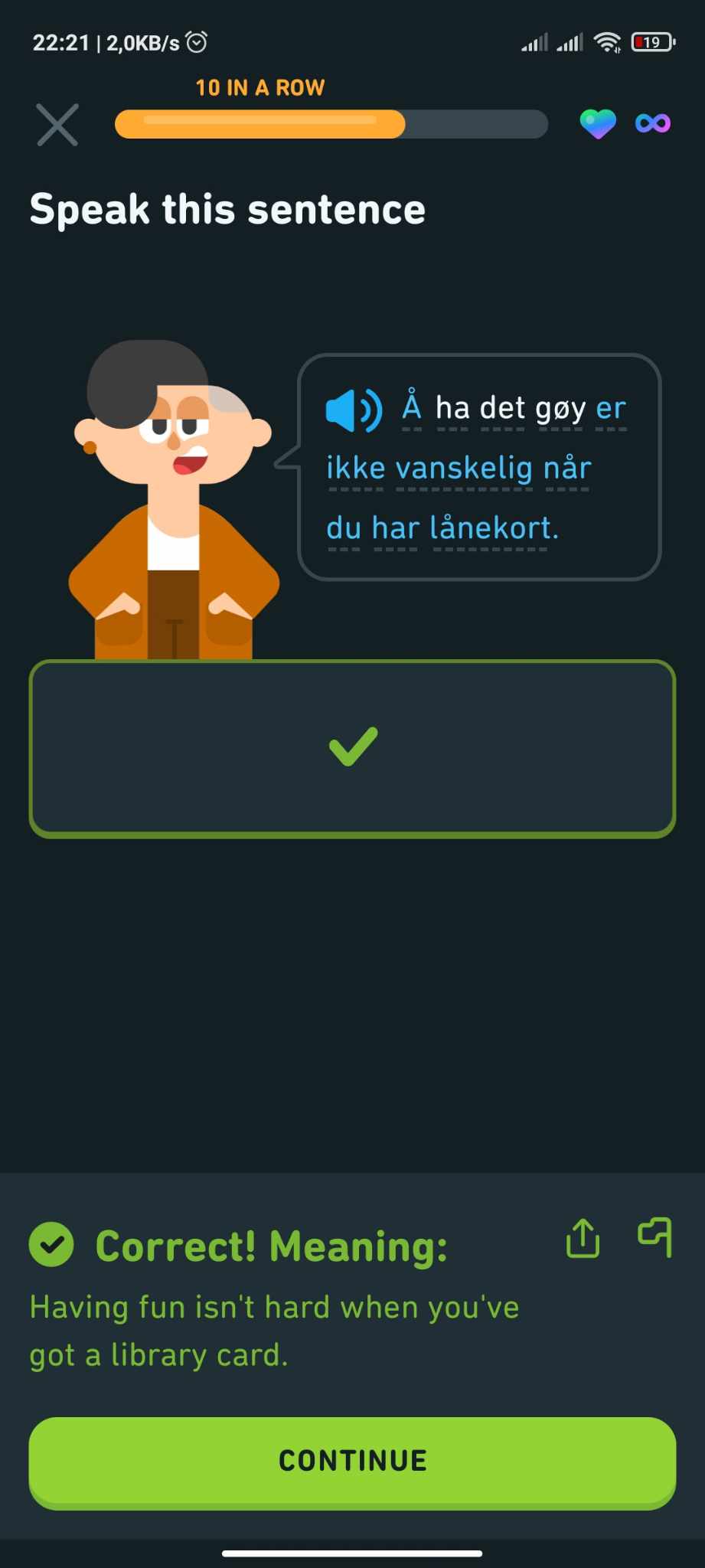
Earlier, I wrote that Duolingo’s gamification system is extremely strong and motivating. But it also pushes learners toward quantity over quality. I wanted to get as many points as possible, so I rushed through lessons quickly and mechanically, often without properly thinking about what I was doing.
This is a major drawback of the app: any form of learning should include what I call the “backside method” – sitting down and focusing. When we reflect on things, we learn them. This doesn’t mean rote memorization, but rather actually thinking and discovering links between things.
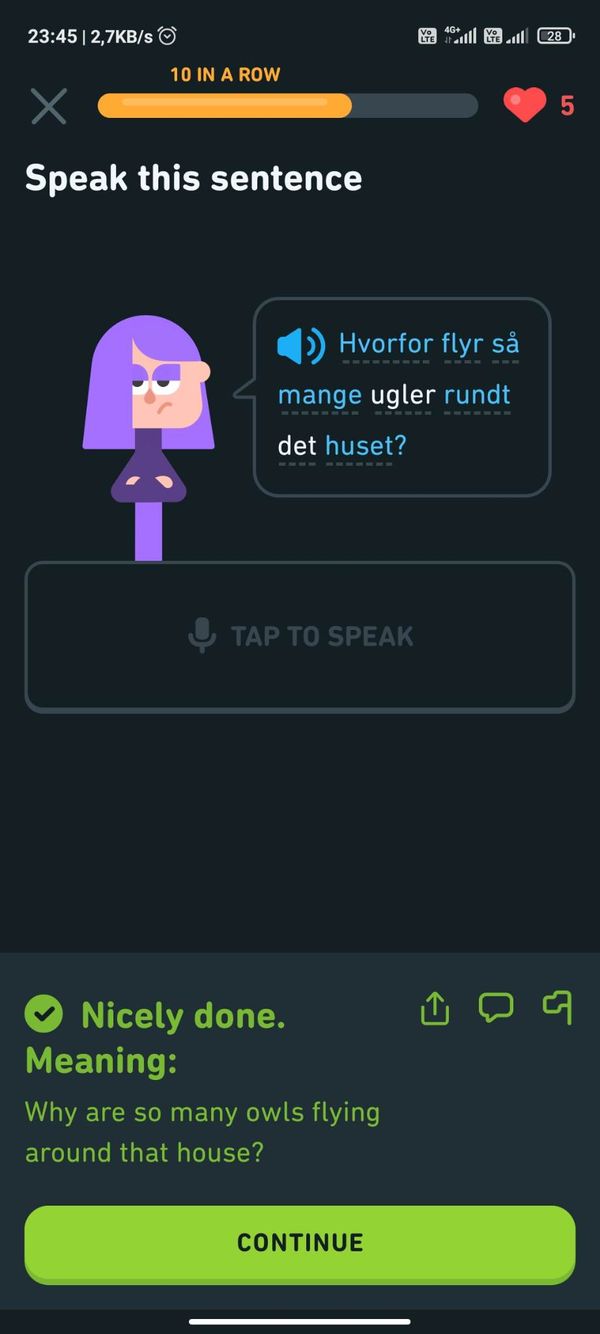
I found it challenging to engage in deep thinking with Duolingo. The gamification elements pushed me forward at a fast pace, which affected my ability to remember words and phrases. The main goal was to extend my “streak” before midnight and not lose it – after all, I was already on 200 days! I think it’s obvious what my learning looked like at 11:45 PM – rushed and done while half-asleep. 🙈
Is Super Duolingo worth it?
And now, let’s take a look at the business side of things. Duolingo is, above all, a very successful company that knows how to monetize its users effectively. It makes money by showing users an INCREDIBLE AMOUNT OF ADS. Of course, their effort to generate profit is understandable – they need to earn their daily bread somehow.
However, from a user’s perspective, if I studied for 15 minutes a day, about 2 to 3 of those minutes were spent watching ads. It may not seem like much, but over a few weeks, those minutes really add up and further reduce the effectiveness of your learning time. I eventually decided to buy a one-year subscription to Super Duolingo (formerly Duolingo Plus) when it was on sale for 37 euros (the regular price is about $84 a year as of October 2026), and I have to say it was a huge relief.
If you really want to learn with Duolingo and you don’t mind the questionable results even after a long period of learning, consider upgrading to Super Duolingo. It’s worth it for sparing yourself the frustration of having to watch constant ads, and it also unlocks several additional features.
Summary: pros and cons of Duolingo
Pros:
- Duolingo is fun and has beautiful graphics.
- The well-designed gamification system keeps you motivated.
- It uses the Spaced Repetition System (SRS), a great tool for memorization (find out more about SRS in this article).
- Super Duolingo comes with useful features.
- You gain passive language comprehension and basic communication skills.
Cons:
- Gamification pushes you toward quantity and keeps you from really thinking about the sentences.
- The abundance of ads will likely push you to purchase Super Duolingo.
- The free version doesn’t allow you to review sentences in which you have previously made a mistake.
- The individual sentences lack context or explanation of the grammar and vocabulary used.
- Over time, you’ll get used to the accents of the voices you hear on Duolingo, and when you later listen to a podcast or have a conversation with a native speaker, you’ll be very surprised by not understanding a thing.
- Duolingo won’t give you active knowledge of the language. Even after a long time spent learning, you’ll only be able to communicate at a level suitable for a vacation at most.
So what’s the takeaway? Treat Duolingo as a supplement to real learning at most, or as a toy to play with on your phone if you aren’t serious about learning a language. You can expect to gain some understanding of the language from it, but forget about becoming a fluent, confident speaker with it. The only way to learn to speak is by speaking – regularly, in real conversations.
Speaking is the most important thing in language learning – nothing moves you forward as fast as actively using the vocabulary and grammar you’ve learned. And there are plenty of other ways to learn a language that will get you to fluency much more reliably than Duolingo.
Frequently asked questions
Will Duolingo really teach you to speak a foreign language?
Not really. Speaking in real life – at work, when you travel or when you talk to people from other countries – takes a different kind of practice than Duolingo offers. Duolingo helps you pick up new words in a fun way, but they’re often out of context or have nothing to do with what you actually need to say. Then, when you have to say something out loud, you get stuck and realize those words don’t help you much.
Is Duolingo enough to learn a language?
As your only tool? Honestly, no. You’ll pick up passive vocabulary and a bit of grammar, but without context and real conversations, you’ll get stuck halfway. Duolingo can be a fun add-on to another method, but as your main tool, it won’t get you to fluency.
How long does it take to learn a language with Duolingo?
There’s no single honest answer, because it depends on what “learning a language” means to you. If you want to read and understand, Duolingo will get you there in a reasonable amount of time. If you want to actually speak, the time you spend in the app won’t help much, because it doesn’t train that skill, no matter how long your streak is.
What’s the alternative to Duolingo if you want to speak fluently?
You need tools that make you produce the language yourself, not just pick the right answer out of three. In practice, that means conversations, watching movies and TV shows actively (not just in the background), or methods that teach you language in context, not in isolated sentences. That’s exactly what the Lydka Method is built on.
Is Super Duolingo worth it?
If you’re thinking about upgrading, it depends on what you want. Super Duolingo removes the ads and adds a few extras, but it doesn’t change how the app works. If you want better results in the language, you’ll get more from other methods. But if you enjoy Duolingo as a fun break from other learning and the ads annoy you, Super Duolingo can be worth it.